
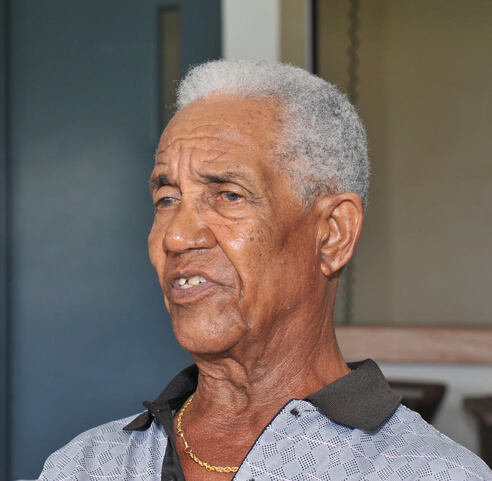
“I developed the skills very well but I wasn’t looking for any glory, glamour or knighthoods or National Hero. I am grateful for all of them and I am thankful to those who thought that I had the ability to give them these things. I am very grateful for that but I didn’t really start out playing my cricket looking for those kinds of accolades. All I wanted to do was to play for my country, play for Barbados, for Police (his BCA club), because every time I came home, I played for Police the same way as I played Test cricket or for Barbados”.
Memory Lane with The Right Excellent Sir Garfield Sobers
By Keith Holder
Bridgetown, Barbados, August 30 – (www.barbadoscricket.org) – In my long career as a sports journalist, it is no secret that covering cricket has given me the greatest satisfaction whether in the print or electronic media.
When I was invited by The NATION newspaper, which was the genesis of my journalism career, to write about The Right Excellent Sir Garfield St. Auburn Sobers, National Hero of Barbados and the world’s greatest ever allrounder, who died on July 17 – 11 days short of what would have been his 90th birthday – so many thoughts ran through my mind that I knew it would be virtually impossible to stick to the limitation of words requested.
I was always “sweet” on cricket statistics from my days at Primary school. Without attempting to go overboard with Sir Garfield, I will forever cherish an extremely lengthy interview with him in 2012. It was part of an online feature produced by the Barbados Cricket Association (BCA) to mark the 120th anniversary of Organised Cricket in Barbados.
Former Barbados captain and West Indies fast bowling great Joel “Big Bird” Garner (now The Most Honourable Joel Garner) was then the BCA president. He spoke to Sir Garfield and we arranged to conduct the interview at Kensington Oval in the comfort of the 3Ws Stand, with the large statue of Sobers in the background as we occasionally gazed at the well-appointed Garfield Sobers Pavilion to our right. The interview incredibly produced over ten thousand (10,000) words.
Sir Garfield’s career statistics are well documented but no story on him can be complete without driving them home. As a left-handed batsman, he played 93 Test matches and scored 8032 runs including 26 centuries and 30 half-centuries, at an average of 57.78. As a left-arm bowler he took 235 wickets at 34.03 runs apiece, bowling either fast-medium, or two styles of spin – orthodox and wrist. He also held 109 catches.
In 383 first-class matches, Sobers amassed 28314 runs with 86 centuries and 121 half-centuries, at an average of 54.87. He bagged 1043 wickets (Ave: 27.74) and held 407 catches.
During the Service for his State Funeral at Kensington Oval on July 29, as the sun shone, Sir Garfield must have been elated with the presence of an extremely strong, world-class team of West Indians. It included two of his contemporaries and long-time close friends, Sir Wesley Hall and Sir Charles Griffith; Sir Clive Lloyd, OCC, who gave the Fraternity tribute; Sir Gordon Greenidge, The Most Honourable Desmond Haynes, who presented Scripture Reading 2; The Most Honourable Joel Garner, Sir Vivian Richards, Sir Andy Roberts, Sir Curtly Ambrose, Collis King and Brian Lara, TC, OCC, who gave a touching tribute.
What a line-up!
Sobers captained West Indies in 39 Test matches (won nine, lost 10, drew 20) – the most until Clive Lloyd came along to carry his formidable teams for 74.
Sobers’ name remained affixed to 365 not out against Pakistan in Kingston, Jamaica in 1958 as the highest Test innings for 36 years until it was passed in 1994 by Lara, a similarly gifted left-hander Sobers had mentored since he appeared in the annual, popular Sir Garfield Sobers International Schools tournament. This year marked the 36th edition and significantly, Sir Garfield died six days before the Final at Kensington Oval.
Following are extracts from my interview with The Right Excellent Sir Garfield Sobers in 2012:
HOLDER: What was it like to carry the tag as the world’s greatest ever all-round cricketer?
SIR GARFIELD: It never really bothered me in anyway because as a youngster playing cricket I always wanted to bat, bowl, field. I always wanted to do everything. I just couldn’t stay on a cricket field and not do something else. I just couldn’t go as a batsman, bowler or even a fielder. I even kept wicket in trials. I stopped keeping wicket because there was a little off-spinner bowling and this batsman played forward and I thought he had the ball covered but it came through between bat and pad, hit the top of the off stump and the bloody ball hit me on my lip and I said ‘I done with that’. After that ‘I said no more wicketkeeping for me’. So, I gave up wicketkeeping but I always wanted to be in the game.
I don’t know about the other islands but in Barbados we used to play a lot of softball cricket and firms where you had about 30 people standing on the field and first bounce was out. You had to get the wicket unless you got it in cohesion with somebody else. But you had to bowl the batsman. You couldn’t let somebody else catch the ball. So, you learnt to bowl fast because you had to penetrate the batsmen because you couldn’t get them out lbw.
I used to bowl fast, spin and even when they picked their little matches, like tennis ball, I would either spin or bowl fast and I enjoyed batting so I learnt from those days.
I went into the game wanting to do everything and my whole policy of the game was to play for my country and to do the best I can for my country.
I never bothered about looking at averages, about how many runs I made or how many wickets I took. I just wanted to be on the occasion when the team was in trouble to be able to bat well enough to pull them out of trouble or go and get a wicket or to take a catch close to the wicket or something like that. But that was my whole idea about playing for the West Indies. The team came first and I came second. So, runs didn’t matter unless there was an occasion where I had to make the runs and take wickets when they wanted them.
And I developed the skills very well but I wasn’t looking for any glory, glamour or knighthoods or National Hero. I am grateful for all of them and I am thankful to those who thought that I had the ability to give them these things. I am very grateful for that but I didn’t really start out playing my cricket looking for those kinds of accolades. All I wanted to do was to play for my country, play for Barbados, for Police (his BCA club), because every time I came home, I played for Police the same way as I played Test cricket or for Barbados.
When I played in a Sunday game I would go out and try to get a fifty and then I would probably get out because that was giving the people who paid to come through the turnstiles a chance to get something back for their money. We had to respect them. We were like performers. We were like on stage and they were the people who paid to watch us and I always believed that we should entertain them. That’s the way I played cricket and that’s the way I reckoned the game should be played. You don’t want to lose, you want to win but also you must be able to entertain because those are the people who practically paid your salaries when you became a professional.
HOLDER: When Brian Lara broke your world Test record of 365 not out in Antigua in 1994, people were saying he was the new Sir Garfield Sobers. Would you say that he was the best of the modern era batsmen?
SIR GARFIELD: Lara was Lara. Lara wasn’t a Sobers.
I saw Brian when he came to my tournament – the first tournament I had of the Sir Garry Sobers Schools’ International competition. I think we had something like ten or 11 teams and Brian was one of those from Trinidad.
I remember I was at home sitting down because I was living across (Highgate Gardens) from the Barclays ground and a little boy came and knocked on my door and said ‘Are you Sir Garfield Sobers? I said ‘yes’ and he said ‘well Mr. Charlie Davis (former Trinidad & Tobago and West Indies batsman) asked me to have a look at a little youngster. So, I went up by Barclays ground and met Charlie and he said ‘Sir Garry, I would like you to meet Brian Lara’. And Brian said ‘are you Sir Sobers, are you Sir Sobers? And I said yes, nice meeting you.
And he went in to bat and you could see he had all the attributes of a great batsman, even then. You couldn’t get him out but he couldn’t get the ball off the square. But his technique was good and you could see that he had determination. I watched him during that series and he played well. He came back the following year and he had grown and I went and looked at him again and he had branched out into a wonderful little player.
He could hit the ball and you could see he was one of these players who was greedy, who wanted runs and he was going to stay there and get runs. He was not going to give it away. He played shots and looked really good.
Early in his career when I thought the West Indies should have picked him, they didn’t.
They took him to England in 1990 but didn’t play him. I heard that he was told he had to wait his turn. I laughed at that because I don’t know what ability has to do with turn.
But then he went on from there. He started to play extremely well, had one or two little faults which he and I did a lot of ironing out because he used to get caught a lot in the slips. He came to me and I talked to him a lot about it and told him why I thought he was getting out caught in the slips and worked with him in the nets.
Wherever he went he used to call me and say ‘have you been watching me, have you been watching me? And I would say yes. And he would ask, what have I been doing wrong? I would say you have been doing alright but outside the off stump, the problem with you Brian is that you get too far over. So, you get so far over that you have to play at the ball. If you just cover your off stump, you would see that the ball is wide and you don’t have to play at it but once you get across and you go a foot outside off stump you bring the ball into play because it is in the region where you got to play at it.
We worked on it and every time he came back to the West Indies or wherever I was he used to wait for me to come into the nets to look at him. He never bothered with anybody else.
HOLDER: When you made the world record 365 not out against Pakistan, it was said that had the crowd not mobbed you on the field and stopped play, you would have probably gone on to score 400. Can you shed any light on that?
SIR GARFIELD: I don’t know much about that. I know I made 365 not out but I don’t know whether I would have made anymore. I don’t think Gerry Alexander would have declared immediately. I think he would have let me bat for another 15 minutes or so to make sure that everything was clear.
But the Jamaican crowd was so pleased and happy for me that in anticipation they ran onto the ground and I was still on the wicket when they trampled over the wicket, and there were little pieces that came out of the wicket and we lost about 15 to 20 minutes. So, Gerry thought ‘well we’ve lost that time and he made a declaration’. But by the time he made the declaration, Hafeez Kadar, who was captain of the Pakistan team, looked at the wicket and saw these pieces out and he said to Gerry we are not going to bat on this wicket this evening until it is properly repaired. So, we lost about an hour to an hour-and-a-half during that period.
I don’t know about making any more runs. I might have got out the next ball.
HOLDER: Have you ever seen a mob like that while you were in the middle?
SIR GARFIELD: No. I have seen crowds like that when bottles were thrown but I’ve never seen a crowd like that on a cricket field while I was playing.
HOLDER: Were you scared at any time when the spectators were on the field?
SIR GARFIELD: Oh, no, no, no. The Jamaicans love me. I had no fear. You see I started my first Test in Jamaica, I made my first hundred in Jamaica, which was a triple, a world record. I captained my first Test match in Jamaica and won it. So, Jamaica has had a lot of wonderful memories for me.
Jamaicans will always remember me because of the success I’ve had in Jamaica and I will always remember Jamaica because I loved playing in Jamaica. I loved the wicket in Jamaica. It was like the Perth wicket. It was fast, bouncy and I don’t think you get better wickets than that. For me, I always liked a fast wicket that bounced.
HOLDER: Who would you rate as the greatest fast bowler and spinner you encountered?
SIR GARFIELD: We had some good ones on our side. I played against them on occasions at home, I played against Wes (Hall) in Australia when he played for Queensland and I played for South Australia. I played against Charlie (Griffith) on the odd occasion.
Of the players I played against in Tests, I reckoned Freddie Truman was one of the best. Denis Lillee was a great bowler but I only played one series against him. But I played a lot of cricket against Fred and I always used to tell people how great he was. He was really a great bowler. He was a tearaway fast bowler when I first played against him in 1954. As a matter of fact, he got me ducking from a ball that never got up. And I remember that I never ducked from a ball after that. But I played a lot against him in England and the beauty about fast bowlers of his calibre and Wes Hall, Michael Holding and all the great West Indian fast bowlers is that they had a heart, a big heart and that they would bowl under any conditions. You give them the flattest of wickets and they would run up and bowl. And Fred was like that all the time. A flat wicket, a batsman’s paradise and he still kept coming at you and you keep saying to yourself what is he seeing in this wicket?
He kept coming at you all the time, and that is the kind of bowler I like. And in my team and I don’t mind playing against because you know that he is trying to get you out.
Fred used to move the ball and he had a good length. He was pretty quick when he first started and very accurate. You always had a tough time against him especially in England in those days on the green tops. Well, you don’t see them these days and when you do get one, nobody can’t play on them.
I would say that Freddie was one of the best I played against. Brian Statham was very good too. Statham was pretty accurate so you knew when you got in where the ball was going to come. Freddie was erratic when he first started.
Alan Davidson was another good bowler but I don’t if Alan had the same heart because I knew at times that Richie (Benaud) had to urge him on when the wicket became flat. Alan would either pull a muscle or something would go wrong and Richie had to say ‘come on Alan, come on’ but he was a very, very good bowler.
John Snow was another good one. These are all the fast bowlers I played against apart from our West Indian fast bowlers.
HOLDER: And who did you rate as great spinners?
SIR GARFIELD: Oh, (Subhash) Gupte. When it came to leg-spinners, Gupte. Gupte was far the best spinner I’ve played against. Bishan Bedi was a very, very good left-arm spin bowler and Jim Laker and Lance Gibbs as off-spinners.
Well, I played a lot against Lance when I played for Barbados. He was a great spin bowler. (Tony) Lock was a little bit dodgy and I think he knew it himself and in the long run he was sorted out because I remember playing against him when he played for Western Australia and I played for South Australia and I remember sitting down in his home one day because he had a bar with photographs and that kind of thing.
He invited me to his home and we were talking about cricket and he said ‘Garry boy, if I am bowling now, I don’t know what I used to do before (Sobers has a chuckle). They tried to straighten him out in Australia and they did because he started to bowl and was still bowling well but he was a little bit dodgy.
But Gupte was definitely the best because Gupte had two ‘googles’. I don’t know any other spinner who bowled two ‘googles’. He used to bowl one high up and one from a kind of round armish thing. And he was very accurate.
In 1953 when he came to the West Indies and our wickets in those days were really, really good and I think he got something like 28 wickets in that series. And Everton (Weekes), Frank (Worrell) and Clyde (Walcott) were playing. I remember they once sent for Robert Christiani to come and play because they reckoned he was one of the best spin bowler batsmen in the West Indies. I watched that game and I remember when Gupte drew him down the wicket if he had run down the other side and the other fellow ran up the other fellow would have got out. He was so far down.
There were other good bowlers like Prasanna, a wonderful off-spinner, and there were many others but my outstanding bowlers (spin and pace) were Jim Laker, Subhash Gupte, Freddie Truman, (John) Snow and Alan Davidson. Richie Benaud was very good too. He didn’t spin the ball as much but he was very, very accurate.
And then you had Johnny Gleeson who was a mystery bowler but I didn’t play against him a lot but overall the Trumans, Lakers and Guptes were the best in their class.
HOLDER: When did you start playing cricket?
SIR GARFIELD: I started playing cricket in Barbados in 1951-52 and that was when I went up to play at Penny Hole, which is now known as Gemswick, in St. Philip.
I did very well in the ‘country’ cricket and I came back and they had the Country versus the BCA match, and I was selected to play for the Country team. I did very well in that match and then I was selected to play in the trials. There was a squad of about 26 and I was very fortunate to get into it.
In those days the game was far different. I don’t know if the same thing exists these days where you have a BCL XI playing against a BCA XI. I don’t follow the local cricket as much as I used to but that was a very good thing because it had shown up a lot of players because over the years, looking back as far as then and even before then, a lot of the Barbados players came from the BCL – Everton Weekes, Clairmonte Depeiza, Conrad Hunte, myself, Seymour Nurse, Charlie Griffith. You could go and on and on. I am sure there were many more. Those are whom I remember at the moment.
It gave a good insight to what the League was because the League was very strong. But it was over the old policy that we had in Barbados for so many years where if you were a Coloured fellow and you didn’t go to Harrison College or Combermere, you couldn’t get into Empire or Spartan.
And, therefore, I was very fortunate when I got into Police. And Everton played for JFC, the Army, and we apparently did so well through the League that people (clubs) like Police and those recognised the talent and this was done through Denis Atkinson, who I used to bowl at during those early days when I was about 11 or 12 years of age.
I used to go up on the pasture and Denis used to send for me nearly every evening when I got home from school to come and bowl at him. And I used to go up there and bowl at him and he recommended me to Captain (Wilfred) Farmer and that is how I got into Police because I didn’t go to Harrison College or Combermere, so in those days I couldn’t get into Spartan or Empire.
So, I had to find another way out and luckily for me the way was found through the Police Boys’ Club because I tried to get into the Band and that didn’t work out as I would have liked, and therefore the suggestion was that I was a member of the Police Boys’ Club, if it was possible to have a youngster from the Police Boys’ Club playing for Police.
And I think the BCA knew it was me so they said ‘yes’ and that’s how I got in.
Cricket in those days was phenomenal. Club cricket back in the 1950s when I started playing and even before, because before I started playing I used to watch and score at the Wanderers ground, and I used to watch all of the teams and I was very fortunate because the scoreboard had a kind of platform which I used to stand up on and when Spartan and Wanderers or Empire or Pickwick played where there were big crowds.
I had an opportunity to see the game and to watch players like Everton (Weekes), Frank (Worrell), Clyde (Walcott), George Carew and all of those players that were playing for the West Indies. Also, Denis Atkinson, Roy Marshall and Norman Marshall.
I learned my game that way. Cricket was of a very, very high standard in those days. Barbados teams in those days certainly would have been superior to a West Indies team in the last ten, 12 years because Barbados had so many good players and as years went on, playing for Police. And then I went to England with the West Indies team in 1957 and went back and played in the Leagues in England from 1958 until 1968 because I went to Notts (Nottinghamshire) in 1968.
Cricket was blooming. We had players in those days like Donald Weekes. Donald Weekes would walk into any West Indies team now. Even my brother Gerald, Wil Clarke, Bossie Barker and the Daniel boys. I mean the cricketers that we had in those days were superior to what we have now. The laws were different. The conditions that we played under in those days were far different to what we have now.
During the 1960s and 70s and later on they started to have covers but in those days there were no covers. We played on wet wickets. I think you learn a lot by playing on wet wickets. You learn how to watch the ball a lot more and watch it on to the bat, especially when the ball was turning you had to keep a very close eye on it.
If you had to play Charlie Griffith, Wes Hall, Carl Mullins and Bossie Barker, Hughley Barker and all of those fellows on wet wickets, you were in for a hiding to nothing. You had to really know what you were looking for. You had to be a player who understood what wickets were playing like to be able to bat because the ball used to rise from a very short length under you. The ball used to get up from a good length and you had to learn how to play it. There was no escaping if you wanted to play proper cricket.
Today a lot of those things have changed. Virtually every wicket is covered in Barbados these days and you have the helmet, the chest pads, arm guards and so many other different things which didn’t take place in those days.
In those days a fellow could bowl you six bouncers in an over and the field was set according to what you were bowling. It wasn’t set to the rules. Today a lot of things are done by rules. You can only bowl so many bouncers an over, you can only have two men behind square and if you bowl a ball above a batsman’s waist, a full toss, it’s called a no-ball and if you do it twice you are taken off and not be able to bowl again.
We went through all of those things but we didn’t have helmets or arm pads. Today it has definitely changed tremendously. Today it’s a batsman game because the fast bowlers have gone back. In those days you had fellows who used to drag through the crease and their front foot used to land probably about two or three feet in front of the batting crease.
So, it meant that by the time they delivered off the front foot they were actually on top of you and obviously the law of averages would tell you that the closer you are to a person the quicker the ball is going to travel. So, it is going to get to you a lot quicker and you are going to be able to bowl better bouncers.
We went through all of that. We played a lot of cricket under those conditions and in the last few years things have changed so dramatically.
I had never really come to Kensington as a young boy because as a youngster I always enjoyed playing my cricket and I was not going to leave playing my cricket to go anywhere. So, I used to listen and play all the time.
I came to Kensington when I played in the trials and then when I came back from India in 1953 I remember coming here to watch the Test match but I can’t remember watching any other cricket at Kensington before then.
I listened to cricket on Rediffusion and I had always enjoyed playing and I thought to sit down and watch cricket I was wasting my time. I just wanted to be involved in whatever I was doing. Cricket, football, whatever.
So, I didn’t come to Kensington a lot and then when I came to Kensington I started to play here regularly. The facilities here were nothing to compare with what they are today. The outfield, you couldn’t slide and dive and do what fielders are doing today. You would come up with all the skin off your knees or elbows or something like it. In those early days the wickets weren’t covered either so you were playing on what we used called ‘sticky dogs’. We learned and learned the hard way but Kensington was a place that you always looked forward to because that is where Test cricket was played. Although you had a chance to play on the ground when you played for your team, like I played for Police and in trials, it was still a different atmosphere when you came to the Test match.
In those days they had a schoolboy stand and a lot of people used to watch cricket. Cricket was very big. There were a lot of fanatics who used to sit in the stands and shout across while you were playing. You don’t see any of that these days. You had King Dyall and later Mac Fingall. I remember Bright Eye Sealy who used to sit in the Kensington Stand and heckle you. Kensington was always alive when cricket was being played contrary to what it is today.
Today if you don’t have England and Australia playing in the West Indies you hardly get any crowds. And there were so many good players around.
HOLDER: What’s the true story relating to you and a gentleman named Garnett Ashby as far as your early career is concerned?
SIR GARFIELD: I used to play a lot cricket on the Bayland, at the old Wanderers ground when Wanderers weren’t playing during the week. Everybody recognised even in those days when I was nine, ten, 11 that I had a lot of ability to play the game. And when I got to 12 and 13 they wouldn’t give me a game because they said they didn’t want me to get hurt and scared by fast bowlers like Bladder and Mice and Baby Greene. They were quick and used to play a lot on the Bay pasture on this half a wicket they used to practice on. And when they were picking the team although they knew that even at 12 and 13 I could probably get in the team, they said ‘no, no, we are not going to discourage him and let him get hurt’.
And a team from the country came down, a team from Pennyhole captained by Garnett Ashby. And he brought it down to play against the Bay Pasture XI and I managed to get in that team because it was a country team. And you know how we look at country teams, they don’t have many good cricketers so I had an opportunity to play against them and I did very well. And Garnett Ashby saw that and he went to a chap named Lionel Daniel who used to look after me in those days because my father died when I was very young, six years of age to be exact. I used to play and go around by Lionel and he used to have me work with him in the joiner trade during the holidays like Christmas time and do some caning or polishing to get some money.
Garnett went and asked him and he said ‘no, he is not going anywhere’. We don’t want him to get scared. So, he came and asked my mother and my mother asked me and I said ‘yes’, I want to go. So, my mother said ‘well if Garry wants to go he can go’. So, Garnett used to come for me on his bicycle and take me up to Pennyhole, sometimes on Friday evenings, sometimes early Saturday mornings I used to go up there and play. I played about two games up there, got a lot of wickets, did some batting too and that is how I got started really.
Keith Holder is a veteran, award-winning freelance sports journalist, who has been covering local, regional and international cricket since 1980 as a writer and commentator. He has compiled statistics on the Barbados Cricket Association (BCA) Division 1 (now Elite) and other BCA championships for over four-and-a-half decades. Email: Keithfholder@gmail.com